Web Data Solutions for US Grocery and Quick Commerce
Grocery is the most local business in retail — prices change by store, ZIP code and delivery zone. We give US grocers, CPG brands and quick-commerce platforms the hyperlocal data they need to price, stock and compete trade area by trade area.
National grocery data hides what happens in every neighborhood store
A US grocer or CPG brand competes store by store — and quick-commerce platforms add their own zone-based pricing on top. The same item carries different prices, promotions and stock across stores just miles apart. A blended national figure tells these teams almost nothing; they need data captured where the shopper actually shops.
Hyperlocal grocery data, built for US market reality
We turn the fragmented world of US grocery and q-commerce into structured datasets your pricing, category and brand teams can act on at the local level.
Prices captured by store and ZIP, not a national blend.
Grocery prices, promos and stock refreshed every day.
From your scope to a validated grocery data pilot.
Built for every role in US grocery and q-commerce
One data partner serving grocers, CPG brands, quick-commerce platforms and the teams inside them.
Grocery chains
Price competitively in every trade area, not on average.
CPG brands
Track how products are priced and stocked across grocery.
Q-commerce platforms
Benchmark assortment, pricing and delivery economics.
Pricing teams
Feed hyperlocal competitor pricing into decisions.
Category managers
Find category price gaps store by store.
Private-label teams
Compare own-brand prices against national brands.
Supply & replenishment
Use availability data to protect on-shelf presence.
Strategy & insights
Build local market views from structured grocery data.
Solutions for US grocery and quick-commerce companies
Each solution is a focused dataset — combine the ones that match your priorities.
Grocery Pricing Intelligence
Hyperlocal grocery price, promotion and stock tracking.
View solution →Quick Commerce Analytics
Assortment, pricing and delivery data from US q-commerce.
View solution →Inventory Availability Tracking
In-stock and out-of-stock monitoring across stores.
View solution →Promotion & Discount Tracking
Weekly-ad deals and discount monitoring by category.
View solution →Retail Price Intelligence
Competitor pricing across the wider US retail market.
View solution →Product Matching Intelligence
Match grocery products to competitor listings accurately.
View solution →What US grocery and q-commerce teams achieve
Hyperlocal grocery data drives pricing, category management and brand strategy.
Trade-area pricing
Set prices competitive in each local market.
Competitor benchmarking
Compare a banner against rivals in the same ZIP.
Private-label strategy
Track own-brand gaps against national brands.
Promotion analysis
See how rivals discount staples by region.
Q-commerce monitoring
Track delivery fees and platform pricing.
Out-of-stock control
Catch grocery stock-outs before they lose sales.
From scope to a live grocery data feed
A simple five-step path — and you talk directly to the engineers building your pipeline.
Share your scope
Tell us your products, ZIP codes and platforms.
We build the pipeline
We configure location-level grocery capture.
Validation
Data is cleaned, validated and deduplicated.
You receive data
Clean output via CSV, JSON, API or dashboard.
Ongoing refresh
Daily updates with monitoring and alerts.
A US-focused grocery data partner
We focus on US grocery and q-commerce platforms and US response hours — so your team gets fast pilots and data that is genuinely hyperlocal.

Hyperlocal capture
Prices at store and ZIP level, not a national blend.
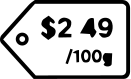
Unit-price normalized
Like-for-like comparison across pack sizes.

Q-commerce aware
Delivery fees captured alongside item price.

Alert-driven
Your team is told when local prices move.
About grocery & quick-commerce web data
Grocery and quick-commerce companies use hyperlocal pricing, promotions, assortment and availability data to price by trade area, manage their catalog and benchmark competitors store by store.
Grocery and quick-commerce prices change by store and ZIP code. A national average hides what shoppers actually see, so the data must be captured at the location level to be useful.
We cover Instacart, Kroger, Walmart Grocery, Amazon Fresh, Gopuff and DoorDash, and can add other US grocery banners and rapid-delivery platforms on request.
Yes. Grocers use the data to price competitively by trade area; CPG brands use it to track how their products are priced and stocked across grocery and q-commerce channels.
We deliver CSV, JSON and Parquet files, REST API endpoints, SFTP and cloud destinations, plus optional dashboards with hyperlocal price comparison.
Compete in US grocery with hyperlocal data
Tell us your products and target ZIP codes and we'll return a sample grocery dataset within 1 business day.