Hospital Price Transparency
Building a usable hospital price transparency dataset means collecting the machine-readable files (MRFs) and shoppable-service information hospitals publish, then doing the hard work of normalising them - because while the data is public and mandated, it comes in wildly inconsistent formats, schemas and code systems. The value is almost entirely in the normalisation: turning thousands of differently-structured files into one clean, comparable dataset keyed to standard codes.
US price transparency rules require hospitals to publish pricing information, including machine-readable files of their standard charges and negotiated rates, plus consumer-facing shoppable-service listings. In principle this is a goldmine for healthtech, payers, benefits platforms and analysts. In practice, the data is notoriously inconsistent - and that inconsistency is the entire problem to solve.
This guide covers the format chaos you will face, how code normalisation makes the data comparable, the QA that makes it trustworthy, and who uses it - written for teams building on healthcare price data.
Hospital price transparency data is a rare case where the raw material is free and mandated, yet a clean, usable dataset remains scarce - because almost all the work, and all the value, is in the normalisation that turns chaos into comparability.
Public and mandated, but not clean
The good news: this data is public and required to be published, which puts it firmly in the collectible, non-personal category. The hard news: there is enormous variation in how hospitals comply. Files differ in format, structure, naming, completeness and the code systems they use. Two hospitals can publish the 'same' information in ways that share almost nothing structurally.
Collecting the files is the easy part. The value - and the difficulty - is in normalising thousands of inconsistent files into one coherent schema with standard codes, so a price at one hospital can actually be compared to another. That is where a usable dataset is made or lost.
The format and schema chaos
Expect to handle wide variation across sources:
- File formats - different structures and layouts, even where a standard exists.
- Code systems - charges tied to different coding schemes (procedure codes, billing codes, internal codes) that must be reconciled.
- Rate types - gross charges, cash/discounted prices, and payer-negotiated rates, structured differently.
- Completeness - varying levels of detail and missing fields across hospitals.
Code normalisation: the key step
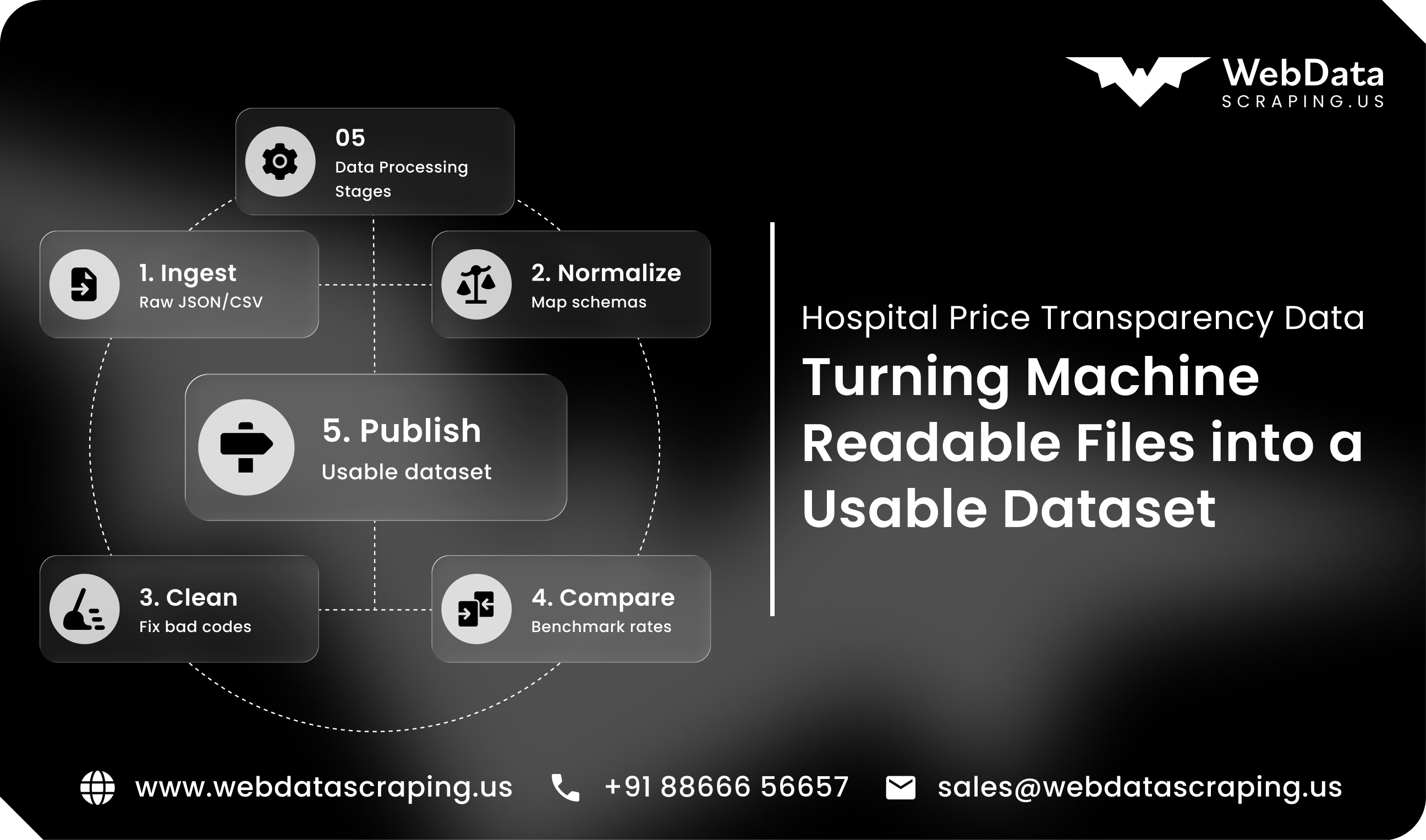
The step that turns raw files into a dataset is normalisation - mapping each hospital's charges to standard codes and a common schema, so a given procedure or service can be found and compared across hospitals. This is where most of the engineering goes, and where accuracy matters most: a wrong code mapping produces a wrong comparison that looks authoritative. Conservative mapping, with ambiguous cases flagged for review, is essential.
Deduplication and consistency checks follow, so the same service is not double-counted and the schema holds across thousands of sources. This is the discipline behind our data cleaning and enrichment work, applied to a famously messy source.
Quality assurance
Given the source inconsistency, QA is not optional. A usable hospital price dataset needs validation that catches malformed values, missing required fields and implausible prices; consistency checks across hospitals; and provenance so every value traces back to the hospital file it came from. Without this, the dataset inherits the chaos of its sources.
Who uses hospital price data
- Healthtech and price-transparency products - powering consumer tools that compare costs.
- Payers and benefits platforms - benchmarking rates and informing network and plan design.
- Analysts and researchers - studying price variation across hospitals and markets.
- Employers and TPAs - understanding the cost landscape for their populations.
This is general information about working with public, mandated disclosures and is not legal advice; specific use should be confirmed with your own compliance and legal teams.
From files to a usable product
Collecting the files is step one; the gap between raw files and a product teams can build on is wide. A usable hospital price dataset is one where a given procedure or service can be looked up and compared across hospitals, keyed to standard codes, with confidence in the values. Getting there means layering structure onto inconsistent sources: a common schema, normalised codes, resolved rate types (gross, cash, negotiated), and validation throughout.
It also means keeping the dataset current. Hospitals update their files, and a transparency dataset that is a one-time snapshot goes stale. Treating it as a maintained feed - re-collected and re-normalised on a schedule, with changes tracked - is what keeps it useful over time rather than a dated extract.
Getting started with hospital price data
- Scope your hospitals. The systems, regions or markets relevant to your product or analysis.
- Define the fields. The charge types, codes and attributes you actually need - not everything in every file.
- Prioritise normalisation. Agree the common schema and code mappings up front; this is where the value is made.
- Build in QA and provenance. Validation and source traceability from the start, given how inconsistent the sources are.
Start with a focused set of hospitals, prove the normalisation produces genuinely comparable data, then expand coverage. This is general information about working with public disclosures and is not legal advice.
What comparability actually requires
The promise of hospital price transparency data is comparison - seeing what a given service costs across hospitals. But genuine comparability is harder than it sounds, and it is where many datasets fall short. For two hospitals' prices to be truly comparable, the same service must be identified consistently (through normalised codes), the rate type must match (comparing cash price to cash price, negotiated to negotiated), and the context must be clear (what is and is not included).
A dataset that puts numbers side by side without resolving these dimensions produces comparisons that look authoritative but mislead - a gross charge at one hospital against a negotiated rate at another is not a like-for-like comparison. Real comparability requires the normalisation, code mapping and rate-type resolution described earlier, applied consistently across every source. This is exactly why the dataset is a normalisation problem: the raw files contain the numbers, but only careful, consistent processing turns them into prices you can actually compare and build a product on. It is painstaking work, and it is the entire difference between a pile of files and a usable dataset.
Frequently asked questions
It is the pricing information US hospitals are required to publish - machine-readable files of standard charges and negotiated rates, plus consumer-facing shoppable-service listings. It is public and non-personal, but published in highly inconsistent formats that must be normalised to be usable.
Hospitals publish in widely varying formats, schemas and code systems with differing completeness, so the raw files share little structure. The difficulty - and the value - is normalising thousands of inconsistent files into one comparable dataset keyed to standard codes.
Mapping each hospital's charges to standard codes and a common schema so services can be compared across hospitals, then deduplicating and running consistency and validation checks, with provenance back to each source file. Conservative code mapping with ambiguous cases flagged is essential for accuracy.
Healthtech and price-transparency products, payers and benefits platforms, analysts and researchers, and employers or TPAs - to compare costs, benchmark rates, study price variation and understand the cost landscape.