Case Studies
These examples show the kinds of problems we solve and how a typical project unfolds — from first challenge to a working data pipeline — across pricing, marketplaces, grocery and brand intelligence.
How US businesses use our web data
Each example follows the same shape — the challenge, what we built, and the outcome.
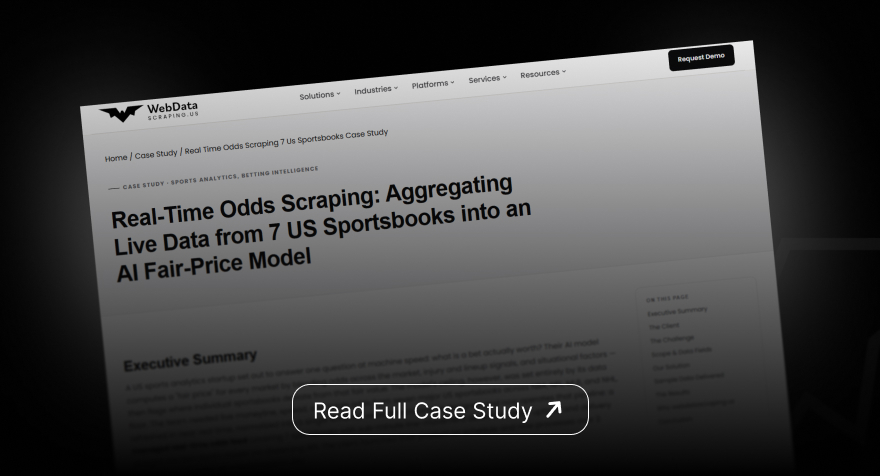
SPORTS ANALYTICS & BETTING INTELLIGENCE
A US sports analytics startup needed near-real-time moneyline, spread, and totals odds across seven sportsbooks and four major leagues. Inconsistent formats, event matching issues, rapid line movements, and changing sportsbook structures made reliable cross-book comparison difficult.
A managed real-time odds pipeline with dedicated sportsbook collectors, canonical event and market matching, normalized odds data, and sub-minute delta detection. The feed also incorporated timestamped injury, lineup, and weather signals and delivered live updates directly into the client's AI fair-price model.
The client achieved a median 22-second line-movement detection latency, 99.93% cross-book event matching accuracy, and 99.95% pipeline uptime. The platform now processes more than 2.1 million odds updates on peak game days.
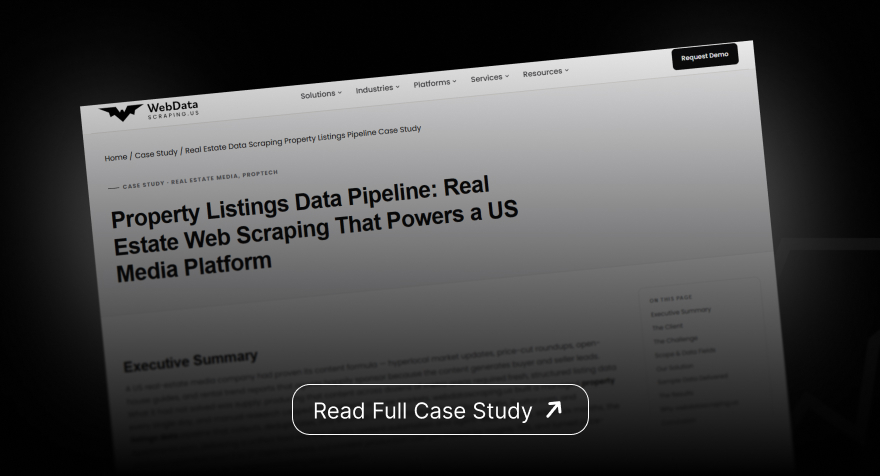
REAL ESTATE & PROPTECH INTELLIGENCE
A US real-estate media platform needed fresh, structured listing data across multiple metros to power hyperlocal content and lead generation. Manual research was time-consuming, while fragmented, duplicate, and stale listings made daily price-change tracking difficult.
A managed property listings pipeline collecting daily data from Zillow, Redfin, Realtor.com, and Apartments.com, with entity resolution, deduplication, price-change detection, and event-based feeds for new listings, price reductions, and status changes.
The platform expanded from 3 to 27 metro markets, automated research, reduced content production costs by 70%, and brought published duplicate rates below 0.5%. Daily price-change detection also became the foundation for its highest-converting lead product.
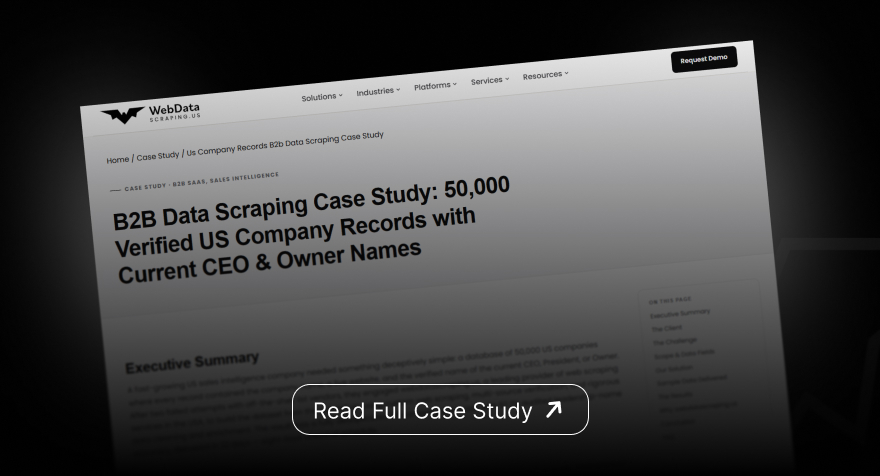
Verified US company data for sales intelligence
A US sales intelligence company needed 50,000 verified business records with live websites and current CEO, President, or Owner names, but generic list vendors struggled with outdated leadership data, dead domains, duplicates, and inconsistent verification.
A custom B2B data extraction pipeline combining public-source scraping, cross-source leadership verification, AI-powered entity matching, deduplication, and human quality control to produce an auditable company database.
The client received 50,000 verified records with 100% live websites, 0% duplicate rate, 100% records verified within 90 days, and 97.2% audited leadership-name accuracy—delivered in 22 days.
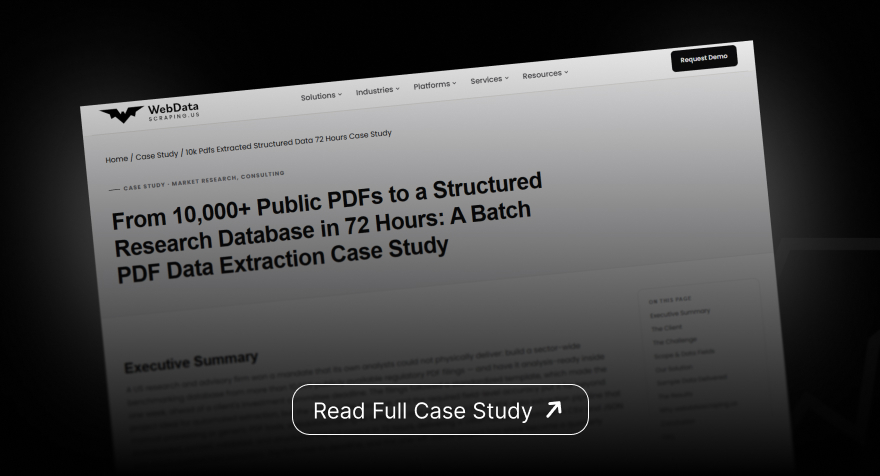
Automated PDF data extraction for research databases
A US research and advisory firm needed to convert 10,000+ public regulatory PDF filings into a structured benchmarking database within a strict one-week deadline, while maintaining high field-level accuracy and handling multiple document template revisions.
A batch PDF data extraction pipeline that classified documents by template, reconstructed structured tables, extracted 42 fields per filing, validated financial and categorical data, and delivered an auditable CSV and JSON dataset with source-page references.
The full corpus of 10,214 PDFs was processed and delivered in 72 hours with 99.6% audited field-level accuracy, while only 1.9% of documents required human review. The resulting pipeline was also reused for quarterly database refreshes.
Used-car price benchmarking across major marketplaces
A US used-car marketplace needed a reliable view of vehicle pricing across CarGurus, Cars.com, and AutoTrader to benchmark listings, help sellers price competitively, and identify genuine deals.
A matched, timestamped used-car listing intelligence feed capturing vehicle attributes, mileage, pricing, location, seller type, days-on-market, and price-drop history, with duplicate vehicles reconciled across marketplaces.
The marketplace gained accurate cross-site price benchmarks, identified underpriced acquisition opportunities, helped sellers reprice aging inventory, surfaced buyer deals, and generated cleaner market statistics through precise vehicle matching and de-duplication.
Shopify competitor catalog intelligence across US DTC brands
A US DTC analytics firm needed to map competitor Shopify catalogs at scale, including assortments, variant-level pricing, launches, and stockouts, across a fragmented market of independent brands.
A normalized, timestamped Shopify catalog intelligence feed capturing products, variants, prices, compare-at prices, SKUs, availability, collections, and tags, with cross-brand product matching and recurring catalog snapshots.
The firm gained a competitive-intelligence engine for monitoring rival assortments, pricing architecture, new product launches, stockouts, and emerging DTC trends across Shopify stores.
The pattern behind every engagement
Typical time from scope to a first validated pilot dataset.
Consistent schema, however many sources a project covers.
Clients work directly with the engineers building the pipeline.
Most pilots become a maintained, monitored data feed.
From first conversation to live data
Every example above followed this same straightforward path.
Scope the challenge
We define the problem, target sites and the fields you need.
Pilot dataset
We build and deliver a validated sample in 3–7 days.
Refine & approve
We adjust the schema and coverage until it fits.
Ongoing feed
The pilot becomes a maintained, monitored pipeline.
About these case studies
The examples on this page describe realistic project types based on the kinds of work we do. Client names and specific figures are kept anonymous to protect confidentiality unless a client has agreed to be named.
Where clients permit, we can discuss relevant examples for your industry on a call. Contact us and tell us your sector so we can share the most relevant context.
Most projects begin with a pilot dataset delivered within 3 to 7 days, followed by an ongoing feed or managed pipeline once the approach is validated.
Contact us with your target sites and the fields you need. We will scope the work and return a sample dataset so you can evaluate quality before committing.
Make your project the next example
Tell us the challenge you're facing and we'll return a sample dataset within 1 business day.